UTILIZATION OF DIGITAL MARKETING IN SUSTAINABLE TOURISM DEVELOPMENT IN PEMATANG JOHAR
Published:
2026-01-04Downloads
Abstract
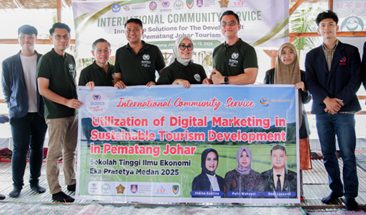
This community service activity aims to improve the digital capabilities of MSMEs and rice field tourism managers in Pematang Johar Village, Deli Serdang Regency, through the implementation of digital marketing to support sustainable tourism development. This village has significant potential in the agrotourism and local product sectors, but has not been fully optimized through technology-based promotional strategies. The activity was implemented using a participatory and educational approach, including preparation, training, mentoring, and evaluation. A total of 30 participants consisting of MSMEs and village tourism managers participated in training on creating digital business accounts, designing promotional content, and implementing marketing strategies through social media and marketplaces. Evaluation was carried out through pre- and post-tests to measure participants' understanding, as well as field observations of the practical application of the training outcomes. The results showed significant improvement, with 87% of participants able to operate digital promotional media independently. The implementation of digital marketing strategies had a positive impact on increasing local product sales by 40% and tourist visits by 25%. This activity demonstrated that digitalization of tourism promotion and MSMEs can strengthen the synergy between sustainable tourism and community economic empowerment, as well as create a technology-based, inclusive and sustainable tourism village development model.
Keywords:
Community empowerment Digital marketing MSMEs Sustainable tourism tourist villagesReferences
Deb, S. K., Nafi, S. M., & Valeri, M. (2024). Promoting tourism business through digital marketing in the new normal era: a sustainable approach. European Journal of Innovation Management, 27(3), 775-799.
Faruk, M., Rahman, M., & Hasan, S. (2021). How digital marketing evolved over time: A bibliometric analysis on scopus database. Heliyon, 7(12).
Ghorbani, Z., Kargaran, S., Saberi, A., Haghighinasab, M., Jamali, S. M., & Ale Ebrahim, N. (2022). Trends and patterns in digital marketing research: bibliometric analysis. Journal of Marketing Analytics, 10(2), 158-172.
Jadhav, G. G., Gaikwad, S. V., & Bapat, D. (2023). A systematic literature review: digital marketing and its impact on SMEs. Journal of Indian Business Research, 15(1), 76-91.
Krishen, A. S., Dwivedi, Y. K., Bindu, N., & Kumar, K. S. (2021). A broad overview of interactive digital marketing: A bibliometric network analysis. Journal of Business Research, 131, 183-195.
León-Castro, M., Rodríguez-Insuasti, H., Montalván-Burbano, N., & Victor, J. A. (2021). Bibliometrics and science mapping of digital marketing. In Marketing and Smart Technologies: Proceedings of ICMarkTech 2020 (pp. 95-107). Singapore: Springer Singapore.
Oka, I. M. D., & Subadra, I. N. (2024). Digital marketing for sustainable tourism village in Bali: A mixed methods study. Journal of Infrastructure, Policy and Development, 8(7), 3726.
Ravi, S., & Rajasekaran, S. R. C. (2023). A perspective of digital marketing in rural areas: A literature review. International Journal of Professional Business Review: Int. J. Prof. Bus. Rev., 8(4), 26.
Suprayitno, D. (2024). Analysis of customer purchase interest in digital marketing content. Journal of Management, 3(1), 171-175.
Van Esch, P., & Stewart Black, J. (2021). Artificial intelligence (AI): revolutionizing digital marketing. Australasian Marketing Journal, 29(3), 199-203.
Wibawa, I. P. A., Astawa, I. P., Sukmawati, N. M. R., Arjana, I. W. B., & Sutarma, I. G. P. (2022). Digital marketing and sustainable tourism for tourist villages in Bangli regency. International Journal of Glocal Tourism, 3(2), 88-99.
License
Copyright (c) 2026 Muammar Rinaldi, Ihdina Gustina, Putri Wahyuni, Dedy Lazuardy

This work is licensed under a Creative Commons Attribution-ShareAlike 4.0 International License.
Downloads
How to Cite