EMPOWERING THE MEUNASAH ALUE VILLAGE COMMUNITY IN FLOOD DISASTER MITIGATION THROUGH ENVIRONMENTAL EDUCATION AND ACTION IN MUARA DUA DISTRICT, LHOKSEUMAWE CITY."
Published:
2026-01-24Downloads
Abstract
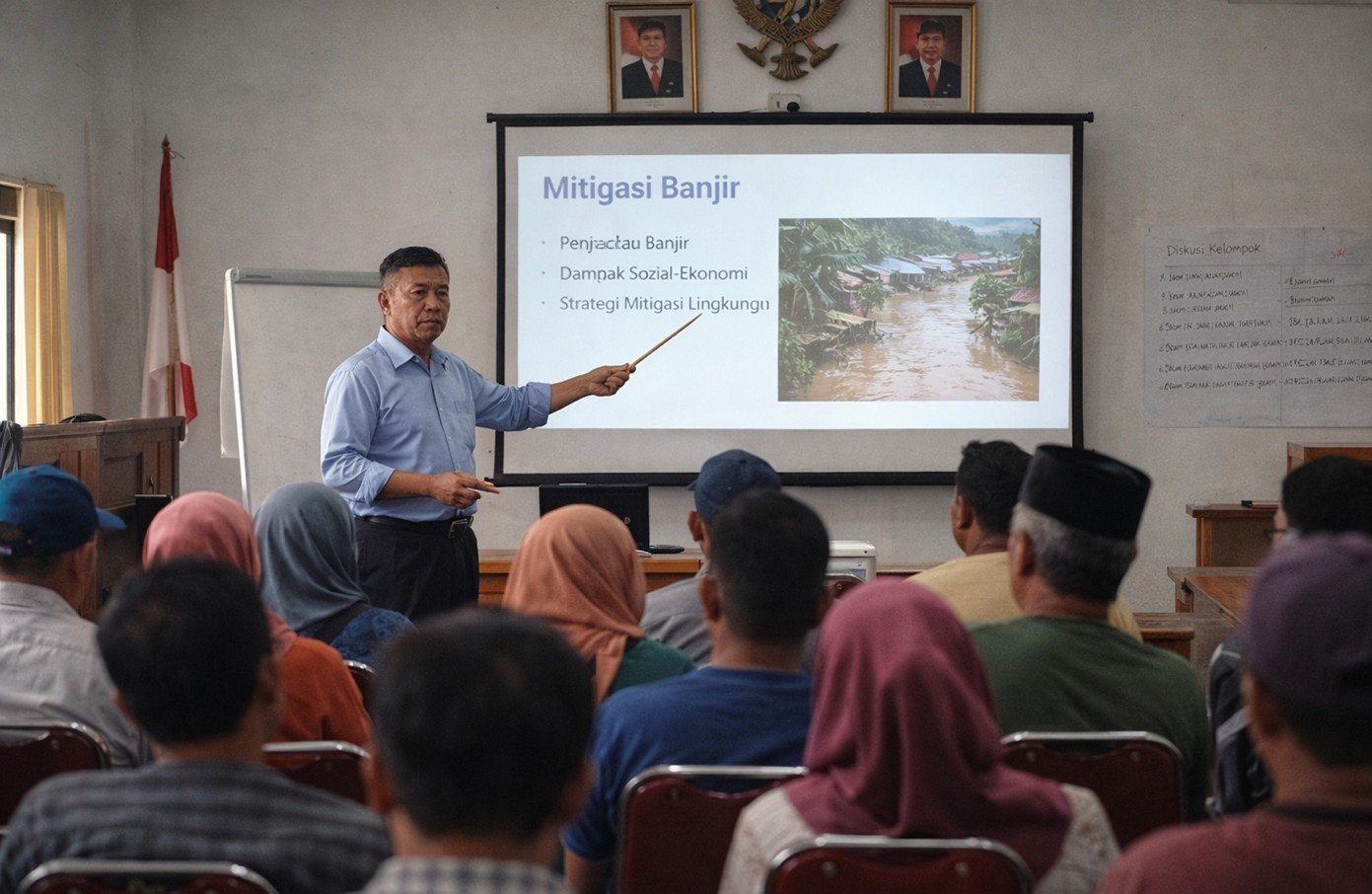
Flooding is a natural disaster that frequently affects coastal areas in Aceh, including Meunasah Alue Village in Muara Dua District, Lhokseumawe City. This condition is caused by high rainfall, suboptimal drainage systems, and low public awareness of environmental cleanliness. This community service activity aims to increase community capacity and awareness in flood mitigation through participatory-based environmental education and action programs. The implementation method uses the Participatory Action Research (PAR) and Community-Based Disaster Risk Reduction (CBDRR) approaches that directly involve the community in the planning, implementation, and evaluation of activities. The program was implemented for three months through stages of flood mitigation education, environmental actions (cleaning ditches, planting vegetation, and creating biopores), and the formation of Village Flood Alert Groups (KSBD). The results of the activity showed a 38% increase in community understanding, a decrease in inundation points from 14 to 6 points, and increased active participation of residents in maintaining environmental cleanliness. In addition to the physical impact, this activity also strengthened collective awareness, social solidarity, and coordination between the community and the village government. Thus, community empowerment through environmental education and action has proven effective in building community resilience to flood risks at the local level and can be used as a model for replication in other areas with similar characteristics.
Keywords:
Flood mitigation Community empowerment Environmental education Community participation Disaster resilience.References
Abid, S. K., Sulaiman, N., & Al-Wathinani, A. M. (2024). Community-based flood mitigation in Malaysia: Enhancing public participation and policy effectiveness for sustainable resilience. Sustainability Science, 19(2), 111–125.
Aldridge, R., & Watson, N. (2021). Community engagement for flood resilience: Lessons from participatory approaches. Journal of Flood Risk Management, 14(2), e12644.
Ansari, M. S., Warner, J., Sukhwani, V., & Shaw, R. (2022). Implications of flood risk reduction interventions on community resilience: An assessment of community perception in Bangladesh. Climate, 10(2), 20.
Atanga, R. A. (2020). The role of local community leaders in flood disaster risk management strategy making in Accra. Sustainable Cities and Society, 52, 101870.
Bott, L. M., Pritchard, B., & Braun, B. (2020). Translocal social capital as a resource for community-based responses to coastal flooding – Evidence from Java, Indonesia. Geoforum, 115, 34–45.
Cabello, V. M., Vélez, K. D., & Moncada-Arce, A. M. (2021). Disaster risk reduction education: Tensions and connections with sustainable development goals. Sustainability, 13(19), 10933.
Da-Silva-Rosa, T., & Mendonça, M. B. (2015). Environmental education as a strategy for reduction of socio-environmental risks. Ambiente & Sociedade, 18(4), 121–136.
Dwirahmadi, F., Rutherford, S., & Phung, D. (2019). Understanding the operational concept of a flood-resilient urban community in Jakarta, Indonesia. International Journal of Environmental Research and Public Health, 16(20), 3993.
Goh, K. C., Kurniawan, T. A., Goh, H. H., & Zhang, D. (2024). Infrastructure resilience for climate change mitigation: Case studies from Southeast Asia. ACS ES&T Water, 4(6), 899–910.
Habiba, U., Shaw, R., & Abedin, M. A. (2013). Community-based disaster risk reduction approaches in Bangladesh. Springer.
Hamzat, K. A. (2021). Effects of environmental education on knowledge, attitude, and practices of flood disaster prevention among residents in Nigeria. International Journal of Environmental Studies, 78(5), 842–856.
Imperiale, A. J., & Vanclay, F. (2021). Conceptualizing community resilience and the social dimensions of risk. Sustainable Development, 29(2), 230–242.
Kagawa, F., & Selby, D. (2012). Ready for the storm: Education for disaster risk reduction and climate change adaptation. Journal of Education for Sustainable Development, 6(2), 107–118.
Khan, M. S., Rahman, M. M., & Chowdhury, S. (2023). Participatory flood mitigation and community resilience in Southeast Asia. Natural Hazards, 118(1), 421–438.
Mahardhika, G. R., & Pamungkas, A. (2024). A systematic review of participatory approaches in flood risk management: Methods and applications. Journal of Policy Research, 15(2), 213–231.
Maskrey, A. (1989). Disaster mitigation: A community-based approach. Oxfam Publications.
Mendonça, M. B., & Da-Silva-Rosa, T. (2016). Improving disaster risk reduction and resilience cultures through environmental education: A case study in Rio de Janeiro State, Brazil. Springer Climate Change and Health, 211–226.
Nguyen, H., Hien, H. M., Shaw, R., & Thi, T. T. M. (2011). Community-based disaster risk management in Vietnam. International Journal of Disaster Resilience in the Built Environment, 2(3), 206–219.
Oladokun, V. O., & Proverb, K. J. (2024). Sustainable disaster risk reduction through local empowerment strategies. International Journal of Disaster Risk Science, 15(1), 33–49.
Paschalia, Y. P. M., & Doondori, A. K. (2022). Revitalization of disaster mitigation management and community empowerment through CBDRR. Jurnal Penelitian Pendidikan IPA, 8(3), 2368–2377.
Petal, M. (2009). Education in disaster risk reduction. UNISDR Publication Series.
Prasetyo, K. (2022). Flash flood disaster mitigation through environmental education. Geomatics and Environmental Engineering, 16(4), 119–128.
Rafinzar, R., Marpaung, Z. S., & Khairunnisa, T. (2025). Community participation and policy effectiveness in urban flood mitigation: Evidence from Palembang City, Indonesia. Indonesian Governance Journal, 8(1), 147–162.
Rahman, M. A., Dewan, A., & Islam, A. R. M. T. (2020). Community-based flood management and adaptation in low-lying regions. Environmental Research Letters, 15(11), 114015.
Ravazzoli, E., Lavarello-Schettini, R., Oberti, B., & Maino, F. (2025). Community-based approaches in disaster risk reduction and climate change adaptation: An analysis of applied participatory processes. Climatic Change, 182(4), 77–95.
Ruszczyk, H. A., Upadhyay, B. K., & Kwong, Y. M. C. (2020). Empowering women through participatory action research in community-based disaster risk reduction efforts. Progress in Disaster Science, 7, 100107.
Sandaran, S. C., & Selvaraj, S. (2021). Government agencies and their discourses of flood disaster preparedness: Impact on response, action, and community empowerment. International Journal of Disaster Risk Reduction, 66, 102581.
Saputra, A. V., Ardiati, A. S., & Sofiany, I. R. (2025). Community-based disaster mitigation for building flood resilience in Malaka-Timor, Indonesia. Climate and Development, 17(4), 812–825.
Sedyowati, L., & Chandrarin, G. (2020). Economic efficiency of community-based flood risk management: An empirical study from Indonesia. Asian Development Policy Review, 8(2), 33–48.
Shaw, R. (2006). Critical issues of community-based flood mitigation: Examples from Bangladesh and Vietnam. Disaster Management Review, 12(3), 221–236.
Shaw, R. (2014). Overview of concepts: Education for sustainable development and disaster risk reduction. Springer Nature.
Shaw, R., Takeuchi, Y., & Rouhban, B. (2009). Education, capacity building and public awareness for disaster reduction. Springer Disaster Risk Studies, 261–278.
Sunarharum, T. M., & Sloan, M. (2014). Community engagement for disaster resilience: Flood risk management in Jakarta, Indonesia. Procedia Engineering, 118, 825–832.
Suryanto, E., Prabowo, R., & Setiawan, H. (2022). Empowering local communities for flood disaster preparedness in Indonesia. International Journal of Disaster Risk Reduction, 70, 102782.
Tahir, R., Akhmad, S., & Iqra. (2022). Effect of disaster risk reduction training based on community participation on flood management preparedness knowledge. Journal of Disaster Science, 11(3), 211–219.
Tanwattana, P., & Toyoda, Y. (2018). Contributions of gaming simulation in building community-based disaster risk management: Applying Japanese cases to flood-prone communities in Thailand. International Journal of Disaster Risk Reduction, 31, 1321–1334.
Tota, W., Maulud, K. N. A., & Noor, N. M. (2024). Impact of community-based adaptation methods in creating resilient communities in Indonesia and the Philippines. Journal of Marine Science and Engineering, 10(5), 5003.
Van Niekerk, D., Nemakonde, L. D., & Kruger, L. (2017). Community-based disaster risk management. Springer Handbook of Disaster Research, 351–372.
Wolff, E. (2021). A people-centred approach to floods: Types of participation in the global literature of citizen science and community-based flood risk reduction. Progress in Disaster Science, 11, 100186.
Yodsuban, P., & Nuntaboot, K. (2021). Community-based flood disaster management for older adults in southern Thailand: A qualitative study. International Journal of Disaster Risk Reduction, 64, 102475.
Zubir, S. S., & Amirrol, H. (2011). Disaster risk reduction through community participation. WIT Transactions on Ecology and the Environment, 148, 223–231.
License
Copyright (c) 2026 Adnan, Aiyub, Muhammad Roni, Munardi, Maisyura

This work is licensed under a Creative Commons Attribution-ShareAlike 4.0 International License.
Downloads
How to Cite