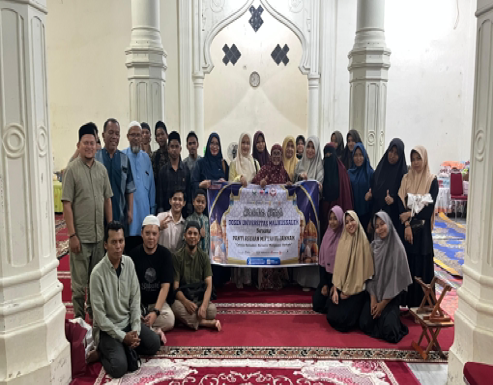
MIFTAHUL JANNAH ORPHANAGE HAS A HAPPY RAMADAN WITH GREAT CHILDREN
Published:
2026-07-26Downloads
Abstract
This article discusses a Ramadan community-service program conducted at Miftahul Jannah Orphanage as a child-centered initiative that integrates Islamic philanthropy, psychosocial support, educational engagement, and joyful worship experiences. The program was developed to respond to the need for meaningful social support among children in alternative care, where material assistance alone is insufficient to strengthen emotional security, dignity, and social connectedness. Using a descriptive qualitative community-service approach, the activity was organized through preliminary coordination, needs identification, participatory preparation, Ramadan sharing, educational games, reflective dialogue, iftar gathering, and post-activity evaluation. Data were interpreted from field observation, documentation, volunteer reflection, and informal feedback from caregivers and children. The results show that a well-structured Ramadan activity can create a warm social atmosphere, support children’s confidence, encourage positive peer interaction, and improve volunteer awareness of ethical service. The study contributes a practical model for faith-based community engagement that emphasizes accountability, child protection, educational value, and sustainable relationships. The program demonstrates that Ramadan social service should not be limited to charity distribution, but should also build inclusive spaces where children are recognized as capable, valued, and great individuals.
Keywords:
child well-being community service Islamic philanthropy orphanage care Ramadan.References
Barry, M. M., Clarke, A. M., Jenkins, R., & Patel, V. (2013). A systematic review of the effectiveness of mental health promotion interventions for young people in low and middle income countries. BMC Public Health, 13, 835. https://doi.org/10.1186/1471-2458-13-835
Bilo, C., & Machado, A. C. (2020). The role of Zakat in the provision of social protection: A comparison between Jordan and Sudan. International Journal of Sociology and Social Policy, 40(3/4), 236-248. https://doi.org/10.1108/IJSSP-11-2018-0218
Celio, C. I., Durlak, J., & Dymnicki, A. (2011). A meta-analysis of the impact of service-learning on students. Journal of Experiential Education, 34(2), 164-181. https://doi.org/10.1177/105382591103400205
Chu, P. S., Saucier, D. A., & Hafner, E. (2010). Meta-analysis of the relationships between social support and well-being in children and adolescents. Journal of Social and Clinical Psychology, 29(6), 624-645. https://doi.org/10.1521/jscp.2010.29.6.624
Ciocanel, O., Power, K., Eriksen, A., & Gillings, K. (2017). Effectiveness of positive youth development interventions: A meta-analysis of randomized controlled trials. Journal of Youth and Adolescence, 46(3), 483-504. https://doi.org/10.1007/s10964-016-0555-6
Desmond, C., Watt, K., Saha, A., Huang, J., & Lu, C. (2020). Prevalence and number of children living in institutional care: Global, regional, and country estimates. The Lancet Child & Adolescent Health, 4(5), 370-377. https://doi.org/10.1016/S2352-4642(20)30022-5
Hillis, S. D., Unwin, H. J. T., Chen, Y., Cluver, L., Sherr, L., Goldman, P. S., Ratmann, O., Donnelly, C. A., Bhatt, S., Villaveces, A., Butchart, A., Bachman, G., Rawlings, L., Green, P., Nelson, C. A., & Flaxman, S. (2021). Global minimum estimates of children affected by COVID-19-associated orphanhood and deaths of caregivers: A modelling study. The Lancet, 398(10298), 391-402. https://doi.org/10.1016/S0140-6736(21)01253-8
Kasri, R. A., & Yuniar, A. M. (2021). Determinants of digital zakat payments: Lessons from Indonesian experience. Journal of Islamic Accounting and Business Research, 12(3), 362-379. https://doi.org/10.1108/JIABR-08-2020-0258
Loades, M. E., Chatburn, E., Higson-Sweeney, N., Reynolds, S., Shafran, R., Brigden, A., Linney, C., McManus, M. N., Borwick, C., & Crawley, E. (2020). Rapid systematic review: The impact of social isolation and loneliness on the mental health of children and adolescents in the context of COVID-19. Journal of the American Academy of Child & Adolescent Psychiatry, 59(11), 1218-1239.e3. https://doi.org/10.1016/j.jaac.2020.05.009
Masten, A. S., & Motti-Stefanidi, F. (2020). Multisystem resilience for children and youth in disaster: Reflections in the context of COVID-19. Adversity and Resilience Science, 1(2), 95-106. https://doi.org/10.1007/s42844-020-00010-w
Prime, H., Wade, M., & Browne, D. T. (2020). Risk and resilience in family well-being during the COVID-19 pandemic. American Psychologist, 75(5), 631-643. https://doi.org/10.1037/amp0000660
Salam, M., Awang Iskandar, D. N., Ibrahim, D. H. A., & Farooq, M. S. (2019). Service learning in higher education: A systematic literature review. Asia Pacific Education Review, 20(4), 573-593. https://doi.org/10.1007/s12564-019-09580-6
van IJzendoorn, M. H., Bakermans-Kranenburg, M. J., Duschinsky, R., Fox, N. A., Goldman, P. S., Gunnar, M. R., Johnson, D. E., Nelson, C. A., Reijman, S., Skinner, G. C. M., Zeanah, C. H., & Sonuga-Barke, E. J. S. (2020). Institutionalisation and deinstitutionalisation of children 1: A systematic and integrative review of evidence regarding effects on development. The Lancet Psychiatry, 7(8), 703-720. https://doi.org/10.1016/S2215-0366(19)30399-2
License
Copyright (c) 2026 Likdanawati, Hamdiah, Jumadiah, Risna Dewi, M. Subhan

This work is licensed under a Creative Commons Attribution-ShareAlike 4.0 International License.
Downloads
How to Cite