REVITALIZING MULU BEBE BANANA PEEL WASTE FROM NORTH MALUKU INTO ECONOMICALLY VALUABLE HEALTH PRODUCTS THROUGH THE EMPOWERMENT OF PKK WOMEN IN JATI
Published:
2026-08-18Downloads
Abstract
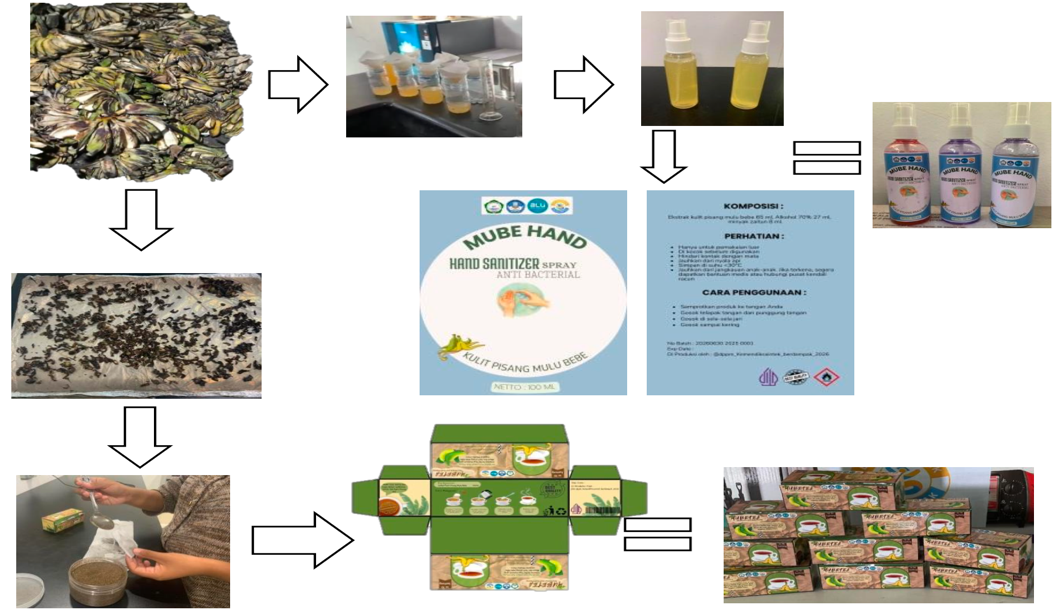
Communicable diseases such as tuberculosis (TB), acute respiratory infections (ARI), dengue hemorrhagic fever (DHF), and malaria remain major public health problems in Ternate City, partly due to low community awareness of Clean and Healthy Living Behaviors (Perilaku Hidup Bersih dan Sehat/PHBS). Meanwhile, the abundant waste of Mulu Bebe banana peels in the area has the potential to be utilized because it contains bioactive compounds with antibacterial and antioxidant activities. Based on these conditions, a Community Service Program (Pengabdian kepada Masyarakat/PkM) was conducted to empower members of the Family Welfare Empowerment (Pemberdayaan Kesejahteraan Keluarga/PKK) group in Jati Subdistrict through the utilization of Mulu Bebe banana peels to produce economically valuable hand sanitizer and herbal tea products. The program was implemented in five stages: (1) socialization on PHBS, the benefits of Mulu Bebe banana peels, hand sanitizer and herbal tea formulations, packaging, marketing, and business management; (2) training in the production of hand sanitizer and herbal tea, packaging design, product marketing, and business management; (3) application of appropriate technology in the production process using standardized equipment; (4) intensive assistance and evaluation through monitoring business development; and (5) program sustainability through consultation facilitation and digital promotion. The results demonstrated an increase in participants' knowledge based on comparisons between pre-test and post-test scores, with the number of participants achieving scores above 80 increasing from 19 in the pre-test to 30 in the post-test. The participants also developed practical skills in producing 50 bottles of hand sanitizer and 25 boxes of herbal tea using the appropriate formulations, as well as the ability to create attractive and marketable packaging designs. Furthermore, the participants began to demonstrate the ability to implement both digital and non-digital marketing strategies and maintain simple financial records. In conclusion, the PkM program successfully improved the participants' knowledge and enhanced their social and economic capacities. Hand sanitizer and herbal tea products derived from Mulu Bebe banana peels not only contribute to efforts to promote PHBS and prevent communicable diseases but also create opportunities for sustainable new businesses for members of the PKK group in Jati Subdistrict.
Keywords:
Community Service Program banana peel Mulu Bebe banana hand sanitizer herbal tea.References
Amalia, M., Rejeki, D. S., & Alfiraza, E. N. (2025). Pemanfaatan limbah kulit pisang Mulu Bebe (Musa acuminata) dalam sediaan foot sanitizer spray sebagai antiseptik alami. Jurnal Farmasi dan Ilmu Kesehatan, 60–69.
Badan Pusat Statistik. (2025). Kecamatan Ternate Selatan dalam angka 2025. Badan Pusat Statistik Kota Ternate.
Burhan, H. (2024). Uji efektivitas ekstrak kulit pisang Mulu Bebe (Musa acuminata) sebagai antibakteri terhadap Staphylococcus aureus secara in vitro. PREPOTIF: Jurnal Kesehatan Masyarakat, 8(3), 7264–7272.
Dinas Kesehatan Kota Ternate. (2024). Laporan kinerja Dinas Kesehatan Kota Ternate tahun 2024. Dinas Kesehatan Kota Ternate.
Haris, R., Burhan, H., & Masrida, W. (2023). Pengembangan wirausaha produk jahe merah untuk kesehatan di Desa Wisata Labuan Bajo Kabupaten Buton Utara. In Prosiding Seminar Nasional (pp. 1–9).
Hikal, W. M., Said-Al Ahl, H. A. H., Bratovcic, A., Tkachenko, K. G., & others. (2022). Banana peels: A waste treasure for human health and nutrition. Sustainability, 14(3), 1–22.
Kementerian Kesehatan Republik Indonesia. (2023). Survei Kesehatan Indonesia (SKI) 2023 dalam angka. Badan Kebijakan Pembangunan Kesehatan, Kementerian Kesehatan Republik Indonesia.
Kementerian Kesehatan Republik Indonesia. (n.d.). Acuan bahan baku obat tradisional dari tumbuhan obat di Indonesia. Kementerian Kesehatan Republik Indonesia.
Kementerian Sosial Republik Indonesia. (2022). Perilaku hidup bersih dan sehat (PHBS): Penguatan kapabilitas anak dan keluarga. Kementerian Sosial Republik Indonesia.
Lestari, D. H., Sukarsono, S., Latifa, R., & Husamah, H. (2017). Kualitas minuman herbal kulit pisang Mulu Bebe (Musa acuminata) pada suhu pengeringan berbeda. Biogenesis: Jurnal Ilmiah Biologi, 5(2), 122–127.
Rosida, D., Diyan, & A. R. (2017). Penentuan aktivitas antioksidan dan kadar fenol total pada ekstrak kulit buah pisang Mulu Bebe (Musa acuminata). Jurnal Ilmiah Farmasi, 2(1), 419–425.
World Health Organization. (2025). Hand hygiene for all: A comprehensive approach to hand hygiene. World Health Organization.
License
Copyright (c) 2026 Hesti Trisnianti Burhan, Nikita Astria, Nur Asma S Somadayo

This work is licensed under a Creative Commons Attribution-ShareAlike 4.0 International License.
Downloads
How to Cite