GREEN WASTE MANAGEMENT BASED ON A CIRCULAR ECONOMY TOWARDS A ZERO WASTE COMMUNITY IN GAMPOENG LANCANG GARAM, LHOKSEUMAWE
Published:
2026-08-23Downloads
Abstract
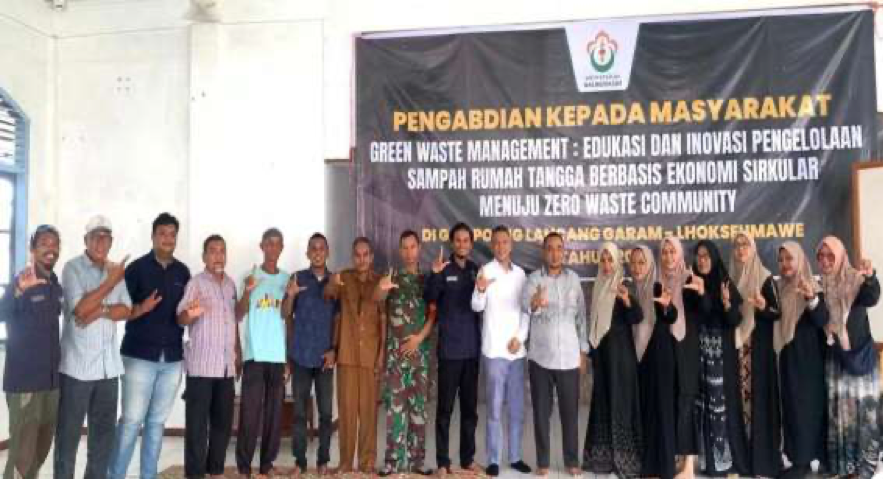
Household waste management at the village level requires behavioral changes, institutional support, and the utilization of waste as a resource. This Community Service activity aims to increase the knowledge, awareness, and skills of the Lancang Garam Village community, Lhokseumawe City, through a circular economy-based Green Waste Management approach towards a zero-waste community. The program was implemented from July to November 2025 with the core activity on November 3, 2025. Methods included initial surveys, interviews and FGDs, outreach, training on waste sorting, organic waste processing, inorganic waste utilization, participatory approaches, education, appropriate technology, and collaboration with officials and community groups. The report results show an increase in understanding and awareness, the implementation of waste sorting from source and processing of organic waste into compost, and the formation of the embryo of a waste management group at the village level. Program achievements also include accepted journal articles, Copyright IPR, online media publications, and an increase in the level of application readiness from the range of 4-6 to 7-8. The findings confirm that participatory education supported by local governance can be the foundation for sustainable, circular economy-based waste management.
Keywords:
circular economy community empowerment green waste management household waste zero wasteReferences
Ajzen, I. (1991). The theory of planned behavior. Organizational Behavior and Human Decision Processes, 50(2), 179-211. https://doi.org/10.1016/0749-5978(91)90020-T
Azwar, S. (2017). Community-Based Waste Management for Environmental Sustainability. Jakarta: Rajawali Pers.
Ellen MacArthur Foundation. (2019). Completing the Picture: How the Circular Economy Tackles Climate Change.
Ellen MacArthur Foundation. (2019). Towards a Circular Economy: Business Rationale for an Accelerated Transition.
Heikal, M. (2017). The Influence of the Theory of Planned Behavior on Consumer Behavior in Waste Management. Journal of Applied Psychology, 5(1), 45-56.
Ichsan, M. (2021). The Importance of Behavioral Change in Waste Management. Antaranews.
Karuniasa, M. (2022). Circular Economy for Empowered Communities. Greeners.co.
Ministry of Environment and Forestry of the Republic of Indonesia. (2020). Guidelines for the Management of Household Waste and Household-Like Waste. Jakarta: KLHK.
Khosravani, A., Rahimi, M., & Sadeghi, H. (2023). Comprehensive urban waste management: Technical, environmental, social, economic, and legal aspects. Journal of Environmental Management, 18(2), 145-158.
King, C., Burgess, J., & Held, A. (2006). Sustainable waste management: Reducing resource use and environmental impacts. Journal of Environmental Policy & Planning, 8(3), 201-217. https://doi.org/10.1080/15239080600829905
Ministry of Environment and Forestry. (2020). National Waste Management Information System (SIPSN).
Lusiantoro, L. (2022). Circular Economy in Communal Environmental Governance. Faculty of Economics and Business, UGM.
Narethong, S. (2020). Integrated waste management and public health: A case study in urban areas. Journal of Public Health and Environment, 12(3), 89-102.
Nasution, MD, & Hidayat, R. (2018). Organic waste management using the composting method at the household level. Journal of Environment and Development, 14(2), 112-119. https://doi.org/10.1234/jlp.v14i2.4567
Noor, A., Santoso, B., & Wibowo, C. (2020). Urban Waste Management: Concept and Implementation. Jakarta: Environmental Science Publisher.
Permana, IK, & Sari, DP (2021). Community-based waste bank model in Indonesia: A case study in Bandung City. Journal of Community Service, 5(1), 34-42.
Putri, AN, & Wijaya, F. (2019). Implementation of a circular economy to reduce plastic waste in tourist villages. Journal of Economics and the Environment, 11(3), 201-210.
Rahim, F. (2020). Environmental and health issues in urban waste management. Journal of Environment and Public Health, 8(1), 25-33.
Ramdani, R. (2024). Analysis of Waste Transport Fleet Capacity in Urban Areas. Technical Report, Lhokseumawe City Environmental Service.
Taelman, J., Rens, B., & Verbeeck, G. (2018). Urban waste management sustainability matrix: Developing a framework for evaluation. Waste Management, 78, 29-41. https://doi.org/10.1016/j.wasman.2018.05.034
Zero Waste International Alliance. (2021). Zero Waste Definition.
License
Copyright (c) 2026 Wardhiah, Mohd. Heikal, Rico Nur Ilham, Muttaqien, Likdanawati, Muhammad Multazam

This work is licensed under a Creative Commons Attribution-ShareAlike 4.0 International License.
Downloads
How to Cite