THE ECOLOGICAL MODEL OF JUSTICE FOR MENTAL HEALTH IN THE WORKPLACE: A HOLISTIC, STRUCTURAL, FAIR, AND DIGNIFIED APPROACH
Published:
2026-09-29Downloads
Abstract
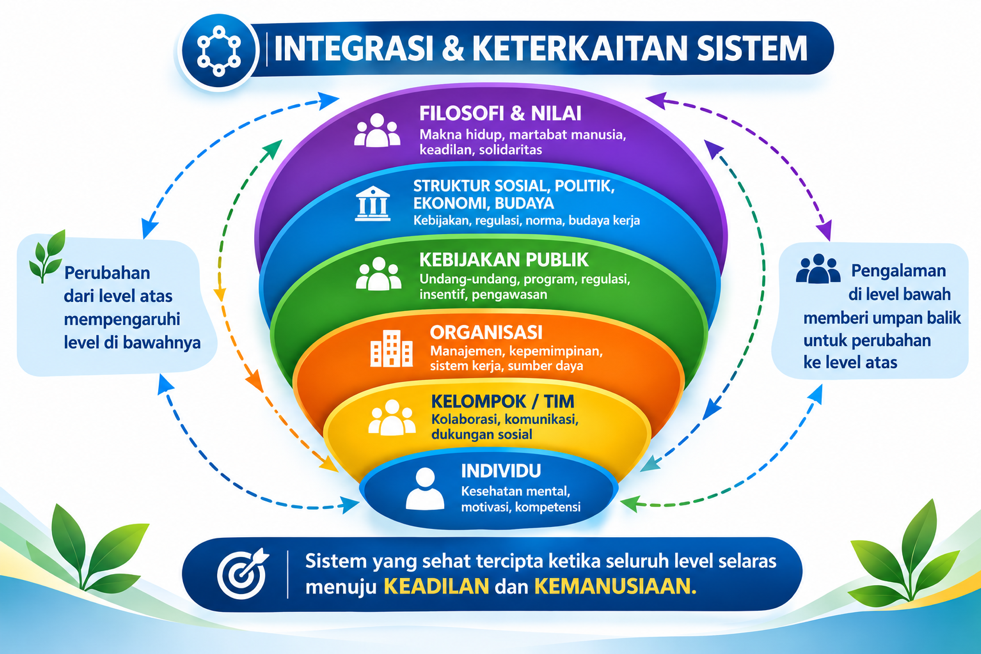
This article formulates an Ecological Justice Model for mental health at work based on materials presented during a university community service webinar with partner organizations on 3 July 2026. The conceptual study uses a narrative synthesis of literature on workplace mental health, psychosocial risks, organizational justice, and relevant policy. The model maps problems across five levels: symptoms, immediate causes, organizational practices, structural roots, and philosophical assumptions. Each level is linked to corresponding intervention strategies. It assigns responsibilities to individuals, organizations, government, and society, guided by justice, human dignity, participation, transparency, sustainability, and the common good. The synthesis indicates that individual support should be connected with changes in job design, organizational governance, and worker protection. The model offers a framework for mapping risks and coordinating action across stakeholders. Because the community service activity collected no pre- and post-event evaluation data, the model's effectiveness cannot yet be established empirically and requires further testing.
Keywords:
ecological model mental health at work organizational justice psychosocial risks workplace dignityReferences
Bakker, A. B., & Demerouti, E. (2007). The Job Demands–Resources model: State of the art. Journal of Managerial Psychology, 22(3), 309–328. https://doi.org/10.1108/02683940710733115
Edmondson, A. (1999). Psychological safety and learning behavior in work teams. Administrative Science Quarterly, 44(2), 350–383. https://doi.org/10.2307/2666999
Harvey, S.B., Modini, M., Joyce, S., Milligan-Saville, J.S., Tan, L., Mykletun, A., Bryant, R.A., Christensen, H., & Mitchell, P.B. (2017). Can work make you mentally ill? A systematic meta-review of work-related risk factors for common mental health problems. Occupational and Environmental Medicine, 74(4), 301–310. https://doi.org/10.1136/oemed-2016-104015
Hobfoll, S. E. (1989). Conservation of resources: A new attempt at conceptualizing stress. American Psychologist, 44(3), 513–524. https://doi.org/10.1037/0003-066X.44.3.513
International Labor Organization. (1999). Decent work for all in a global economy. ILO.
International Labor Organization. (2019). Violence and Harassment Convention, 2019 (No. 190). ILO.
International Labor Organization. (2022). Psychosocial risks and stress at work. ILO.
International Labor Organization. (2023). Sustainable Development Goal 8: Decent work and economic growth. ILO.
International Labor Organization, & World Health Organization. (2022). Mental health at work: Policy brief. ILO & WHO.
International Organization for Standardization. (2021). ISO 45003:2021: Occupational health and safety management—Psychological health and safety at work-Guidelines for managing psychosocial risks. ISO.
Karasek, R.A. (1979). Job demands, job decision latitude, and mental strain: Implications for job redesign. Administrative Science Quarterly, 24(2), 285–308. https://doi.org/10.2307/2392498
Lucas, K. (2015). Workplace dignity: Communicating inherent, earned, and remediated dignity. Journal of Management Studies, 52(5), 621–646. https://doi.org/10.1111/joms.12133
Ndjaboué, R., Brisson, C., & Vézina, M. (2012). Organizational justice and mental health: A systematic review of prospective studies. Occupational and Environmental Medicine, 69(10), 694-700. https://doi.org/10.1136/oemed-2011-100595
PP Number 50 of 2012 concerning the Implementation of the Occupational Safety and Health Management System (SMK3).
Minister of Manpower Regulation No. 5 of 2018 concerning Occupational Safety and Health in the Work Environment
Minister of Manpower Regulation No. 13 of 2025 concerning the Occupational Safety and Health Development Committee (P2K3)
Minister of Manpower Regulation No. 11 of 2026 concerning Procedures for Manpower Supervision
Republic of Indonesia. (1970). Law of the Republic of Indonesia Number 1 of 1970 concerning Occupational Safety.
Ryan, R. M., & Deci, E. L. (2000). Self-determination theory and the facilitation of intrinsic motivation, social development, and well-being. American Psychologist, 55(1), 68–78. https://doi.org/10.1037/0003-066X.55.1.68
Siegrist, J. (1996). Adverse health effects of high-effort/low-reward conditions. Journal of Occupational Health Psychology, 1(1), 27–41. https://doi.org/10.1037/1076-8998.1.1.27
Simatupang, M., Anindyajati, M., Susanti, Y., Respati, WS, & Masitoh, S. (2026). Work engagement and organizational commitment as predictors of organizational citizenship. Journal of Community Service and Community Service Research, (5)1, 2774-2779.
United Nations. (2015). Transforming our world: The 2030 Agenda for Sustainable Development. United Nations.
Westgaard, R. H., & Winkel, J. (2011). Occupational musculoskeletal and mental health: Significance of rationalization and opportunities to create sustainable production systems-A systematic review. Applied Ergonomics, 42(2), 261–296. https://doi.org/10.1016/j.apergo.2010.07.002
World Health Organization. (2022). Guidelines on mental health at work. WHO. https://doi.org/10.1002/wps.20953
World Health Organization. (2022). Mental health at work: Policy brief. WHO.
World Health Organization. (2022). Mental health at work: WHO guidelines and policy brief. WHO.
License
Copyright (c) 2026 Linus K. Palindangan, Marhisar Simatupang, Yulisa Susanti, Yudhi Satria R. A, Aquila Raffi Maari

This work is licensed under a Creative Commons Attribution-ShareAlike 4.0 International License.