SHARIA VILLAGE EMPOWERMENT: STRENGTHENING MICROENTERPRISE CAPACITY THROUGH A UNIVERSITY–COMMUNITY PARTNERSHIP
Published:
2026-11-23Downloads
Abstract
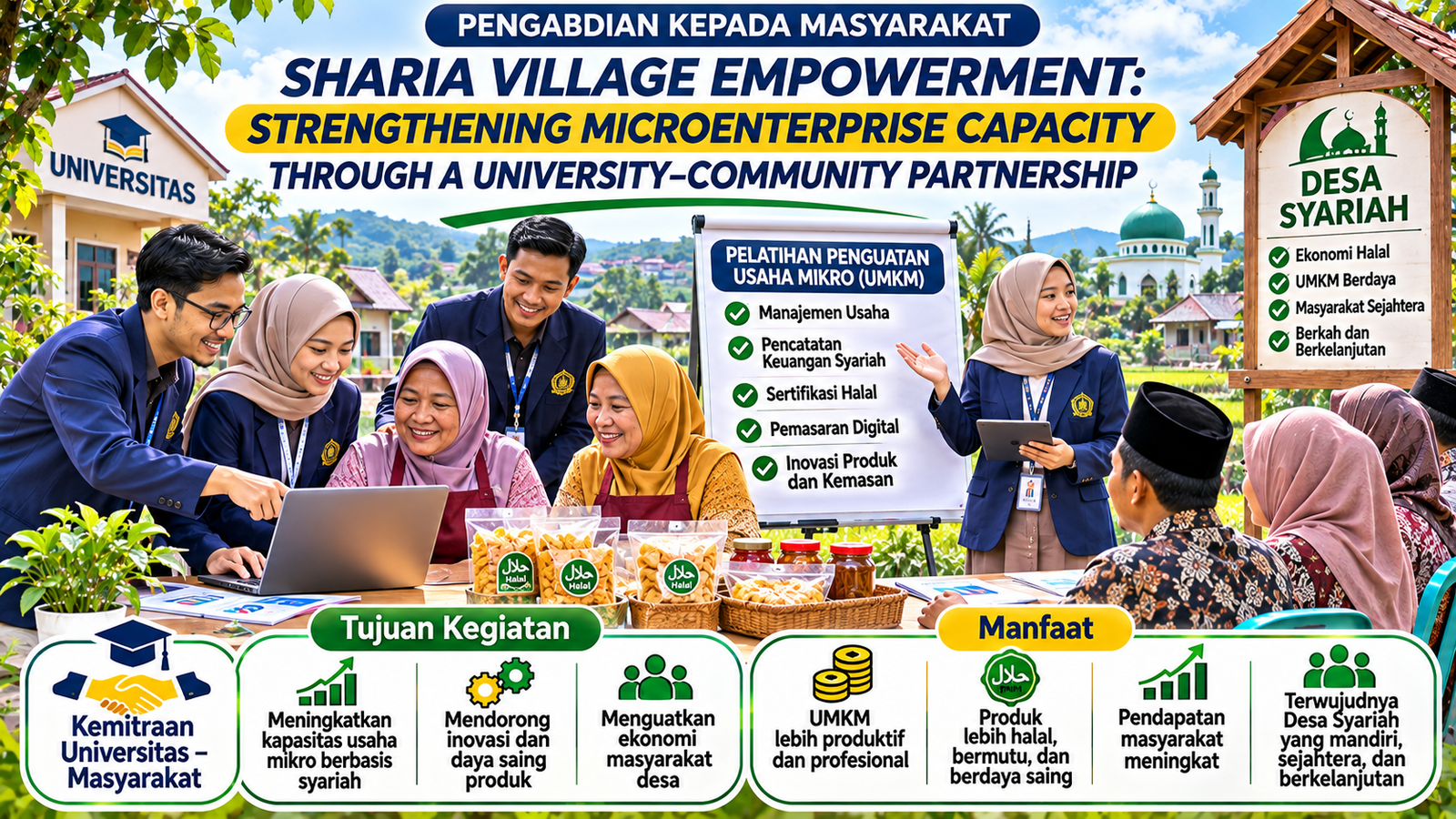
Village-based community empowerment can connect university expertise with the practical needs of microenterprise actors. This community service manuscript develops an implementation framework for the Assisted Village Program conducted by the Islamic Economics Study Program, Faculty of Islamic Economics and Business, UIN Syekh Ali Hasan Ahmad Addary Padangsidimpuan, in Pasar Lama Village, Batang Angkola District, South Tapanuli Regency. The program is directed at improving community knowledge and insight related to Islamic economics for small businesses and community economic welfare. The implementation design consists of an initial meeting with village officials, preliminary community observation, participatory problem mapping, Islamic economic empowerment assistance, review, and closing evaluation. The approach emphasizes community participation, local problem identification, sharia-compliant business understanding, and University village collaboration. Based on the official proposal, the intended outputs are increased economic-welfare knowledge among small-business actors and fulfillment of the university’s community-service mandate. Because the source document is a proposal rather than a post-activity report, this manuscript does not fabricate post-test scores, income growth, or other realized impacts. Instead, it provides a journal-ready intervention design and a measurable evaluation framework that should be completed with verified implementation data before submission. The proposed framework contributes a practical pathway for transforming a village-assistance agenda into an evidence-based and sustainable Islamic economic empowerment program.
Keywords:
community empowerment Islamic economics microenterprises assisted village community serviceReferences
Abdi, M. N., Mukminati, Arsal, M., Naidah, & Said, S. (2026). Penguatan UMKM desa berbasis produk halal menuju desa mandiri dan berdampak. Jurnal Dharma Bhakti Ekuitas, 10(2). https://doi.org/10.52250/dbe.v10i2.1066
Adi, T. B., & Mukhsin, D. (2022). Community empowerment based on Islamic economics to develop an autonomous Muslim village at Baliem Valley of Papua. Journal of Islamic Economics Lariba, 8(2), 371–380. https://doi.org/10.20885/jielariba.vol8.iss2.art15
Albar, K., Putri, L. A., Choirul, A. B., Firnanda, D. A., Zunita, Z., & Alifiransyah, M. R. (2026). Penguatan ekonomi lokal Lipeksi melalui literasi keuangan syariah dan digitalisasi produk unggulan UMKM. Al-Khidmah Jurnal Pengabdian Masyarakat, 6(2). https://doi.org/10.56013/jak.v6i2.6042
Choiriyah, C., Noviani, D., Nopriansyah, W., Juleha, J., & Sari, E. (2025). Pemberdayaan UMKM Desa Gelebak Dalam melalui edukasi keuangan syariah dan penguatan nilai ekonomi Islam. SELAPARANG: Jurnal Pengabdian Masyarakat Berkemajuan, 9(4).
Gumanti, M., & Pariyanti, E. (2026). Financial literacy and well-being of Lampung MSMEs: Evidence from Islamic financing access. Jurnal Economia, 22(2), 238–257. https://doi.org/10.21831/economia.v22i2.84476
Jamaludin, N., & Muizzudin. (2023). The application of Islamic value-based empowerment of MSMEs to improve the performance of micro businesses in Panongan Subdistrict, Tangerang. Indonesian Journal of Community Engagement, 9(3), 176–180. https://doi.org/10.22146/jpkm.78780
Lantip, L., & Muhlis, M. (2025). Peningkatan literasi keuangan syariah dan pemasaran digital pada pelaku UMKM di Desa Lasem, Sidayu, Gresik. SEWAGATI: Jurnal Pengabdian Masyarakat Indonesia, 4(4). https://doi.org/10.56910/sewagati.v4i4.3404
Novianto, A. S., Amin, M. S., Saputri, L. S., Cinta, A., Lestari, V., Riski, K. N., et al. (2025). Sharia financial planning assistance to improve community welfare. Community Empowerment, 10(9), 1818–1825. https://doi.org/10.31603/ce.14159
Rarasati, I., & Amin, H. (2025). The role of religious-based empowerment in enhancing Asnaf entrepreneurs’ success: Evidence from Jogokariyan Mosque, Indonesia. International Journal of Islamic Economics and Finance, 8(2), 164–183. https://doi.org/10.18196/ijief.v8i2.27781
Safitri Hasibuan, D. I., Daulay, A. R., Adawiyah, R., Tanjung, R., & Anugerah, T. (2026). Introduction to Islamic economics for micro, small, and medium enterprises (MSMEs). EKOMA: Jurnal Ekonomi, Manajemen, Akuntansi, 5(4). https://doi.org/10.56799/ekoma.v5i4.15121
License
Copyright (c) 2026 Sry Lestari, Rizki Pratiwi Harahap, Syarifah Isnaini, M. Yarham

This work is licensed under a Creative Commons Attribution-ShareAlike 4.0 International License.