MENTAL HEALTH AT WORK: A MULTI-LEVEL INTERVENTION TO ENHANCE MENTAL HEALTH LITERACY AND HELP-SEEKING AMONG MINING EMPLOYEES
Published:
2026-10-27Downloads
Abstract
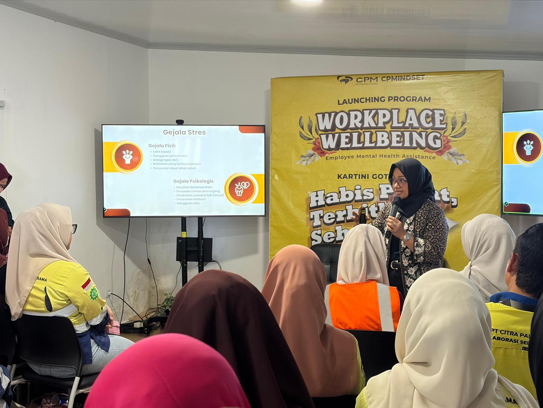
Mining workers face high psychosocial risks, yet stigma and limited mental health literacy keep many of them from seeking help. This community service program set out to improve mental health literacy, self-recognition of stress, and access to psychological services among employees of PT X. It combined four components: a psychoeducational seminar on mental health at the workplace, a stress assessment using the DASS-42 stress subscale, individual psychological counseling, and a pocket guide, the Wellness Support Guide. The program was evaluated descriptively and qualitatively, and all components were delivered as planned. Employees gained a basic understanding of mental health and occupational stress, a self-administered early detection tool, and a clear route to counseling. The assessment worked as an entry point to counseling for employees who needed it, while the guide kept the psychoeducational message within reach after the seminar. The program recommends periodic screening, supervisor training, peer supporters trained in Psychological First Aid, integration of psychosocial risks into occupational health and safety management, and a pre-post design in future evaluations.
Keywords:
counseling mining industry occupational stress psychoeducation workplace mental healthReferences
American Psychological Association. (n.d.). Stress. In APA dictionary of psychology. Retrieved April 19, 2026, from https://dictionary.apa.org/stress
Bakker, A. B., & Demerouti, E. (2007). The job demands-resources model: State of the art. Journal of Managerial Psychology, 22(3), 309–328. https://doi.org/10.1108/02683940710733115
Considine, R., Tynan, R., James, C., Wiggers, J., Lewin, T., Inder, K., Perkins, D., Handley, T., & Kelly, B. (2017). The contribution of individual, social and work characteristics to employee mental health in a coal mining industry population. PLOS ONE, 12(1), Article e0168445. https://doi.org/10.1371/journal.pone.0168445
Greenhaus, J. H., & Beutell, N. J. (1985). Sources of conflict between work and family roles. Academy of Management Review, 10(1), 76–88. https://doi.org/10.5465/amr.1985.4277352
Hanisch, S. E., Twomey, C. D., Szeto, A. C. H., Birner, U. W., Nowak, D., & Sabariego, C. (2016). The effectiveness of interventions targeting the stigma of mental illness at the workplace: A systematic review. BMC Psychiatry, 16, Article 1. https://doi.org/10.1186/s12888-015-0706-4
Ifdil, I., Syahputra, Y., Fadli, R. P., Zola, N., Putri, Y. E., Amalianita, B., Rangka, I. B., Suranta, K., Zatrahadi, M. F., Sugara, G. S., Situmorang, D. D. B., & Fitria, L. (2022). The depression anxiety stress scales (DASS-21): An Indonesian validation measure of the depression anxiety stress. COUNS-EDU: The International Journal of Counseling and Education, 5(4), 205–215. https://doi.org/10.23916/0020200536840
Jorm, A. F. (2012). Mental health literacy: Empowering the community to take action for better mental health. American Psychologist, 67(3), 231–243. https://doi.org/10.1037/a0025957
Joyce, S., Modini, M., Christensen, H., Mykletun, A., Bryant, R., Mitchell, P. B., & Harvey, S. B. (2016). Workplace interventions for common mental disorders: A systematic meta-review. Psychological Medicine, 46(4), 683–697. https://doi.org/10.1017/S0033291715002408
Kementerian Kesehatan Republik Indonesia. (2024). Survei Kesehatan Indonesia (SKI) 2023: Factsheet kesehatan jiwa [Indonesian Health Survey (SKI) 2023: Mental health factsheet]. Badan Kebijakan Pembangunan Kesehatan. https://www.badankebijakan.kemkes.go.id/repositori/id/eprint/5532/
Kementerian Ketenagakerjaan Republik Indonesia. (2018). Peraturan Menteri Ketenagakerjaan Republik Indonesia Nomor 5 Tahun 2018 tentang Keselamatan dan Kesehatan Kerja Lingkungan Kerja [Regulation of the Minister of Manpower of the Republic of Indonesia No. 5 of 2018 on occupational safety and health in the work environment].
Keyes, C. L. M. (2002). The mental health continuum: From languishing to flourishing in life. Journal of Health and Social Behavior, 43(2), 207–222. https://doi.org/10.2307/3090197
Kossek, E. E., Pichler, S., Bodner, T., & Hammer, L. B. (2011). Workplace social support and work–family conflict: A meta-analysis clarifying the influence of general and work–family-specific supervisor and organizational support. Personnel Psychology, 64(2), 289–313. https://doi.org/10.1111/j.1744-6570.2011.01211.x
LaMontagne, A. D., Martin, A., Page, K. M., Reavley, N. J., Noblet, A. J., Milner, A. J., Keegel, T., & Smith, P. M. (2014). Workplace mental health: Developing an integrated intervention approach. BMC Psychiatry, 14, Article 131. https://doi.org/10.1186/1471-244X-14-131
Lazarus, R. S., & Folkman, S. (1984). Stress, appraisal, and coping. Springer.
Le Fevre, M., Matheny, J., & Kolt, G. S. (2003). Eustress, distress, and interpretation in occupational stress. Journal of Managerial Psychology, 18(7), 726–744. https://doi.org/10.1108/02683940310502412
Lovibond, S. H., & Lovibond, P. F. (1995). Manual for the depression anxiety stress scales (2nd ed.). Psychology Foundation of Australia.
Maslach, C., & Leiter, M. P. (2016). Understanding the burnout experience: Recent research and its implications for psychiatry. World Psychiatry, 15(2), 103–111. https://doi.org/10.1002/wps.20311
PT X. (n.d.). Brief history. Retrieved October 12, 2026, from https://bumiresourcesminerals.com/brief-history/
Rhoades, L., & Eisenberger, R. (2002). Perceived organizational support: A review of the literature. Journal of Applied Psychology, 87(4), 698–714. https://doi.org/10.1037/0021-9010.87.4.698
World Health Organization. (2022a, September 28). WHO and ILO call for new measures to tackle mental health issues at work [Press release]. https://www.who.int/news/item/28-09-2022-who-and-ilo-call-for-new-measures-to-tackle-mental-health-issues-at-work
World Health Organization. (2022b). WHO guidelines on mental health at work. World Health Organization.
World Health Organization, War Trauma Foundation, & World Vision International. (2011). Psychological first aid: Guide for field workers. World Health Organization.
Yerkes, R. M., & Dodson, J. D. (1908). The relation of strength of stimulus to rapidity of habit-formation. Journal of Comparative Neurology and Psychology, 18(5), 459–482. https://doi.org/10.1002/cne.920180503
License
Copyright (c) 2026 Maharsi Anindyajati, Marhisar Simatupang, Ari P. Pamungkas, Deva R.K.M Purnama

This work is licensed under a Creative Commons Attribution-ShareAlike 4.0 International License.