HOUSEWIFE EMPOWERMENT STRATEGY TOWARDS HIGHLY COMPETITIVE INDEPENDENT BUSINESSES IN REULEUT TIMUR VILLAGE MUARA BATU NORTH ACEH REGENCY
Published:
2022-06-24Downloads
Abstract
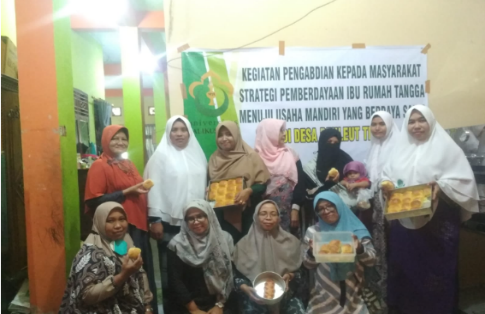
The problem faced by partners is the lack of ideas in business development, moreover, many medium-scale industrial-scale food factories have sprung up while home-scale food production houses have been displaced because they are not able to compete with the quality of products produced by medium-scale industrial factories. The Housewife Empowerment Strategy is intended to foster ideas in business development so as to increase the economy of home-scale food production houses and will be able to become highly competitive businesses. This activity is here to inspire and raise awareness of potential, as well as to develop knowledge, insight, and ideas in the development of the types of food produced. The method used in this activity is a guided training method, namely the method of discussion and training. This service activity focuses on training to make “Bread Sobek” which is one of the promising business ideas. In carrying out this activity requires several stages, namely explaining the ingredients needed in making bread and the function of each of these ingredients through small discussions as well as bread making training so that participants are not only able to make bread but also know the function of the ingredients for making bread. the.The results of the training activities show that new ideas for food variations that can be produced by highly competitive home-scale production houses have emerged, housewives have also been able to apply these new ideas as variations of the torn bread itself. with various variants that can make an independent business highly competitive.
Keywords:
Strategy Empowerment Independent business Bread Highly competitiveReferences
Fritsch, DJ and Strorey, M. 2014. Entrepreneurship in a Regional Context: Historical Roots, Recent Developments and Future Challenges, Regional Studies, Vol. 48 No. 6, pp. 939-954.
Haryono. 1992. Potential and Utilization of Sago. Canisius. Yogyakarta.
Ife, Jim & Tesorierro, Frank. 2008. Community Development: Alternative Community Development in the Era of Globalization, Third Edition (Manullang Literature, Nurul Yakin, M. Nursyahid; translation). Yogyakarta: Student Library
Jenie, Betty Sri Lakshmi. 1993. Food Industry Waste Management. Canisius. Yogyakarta.
Kartasasmita, Ginandja 1996. People's Economic Empowerment Through Partnerships To Realize A Strong And Independent National Economy. National Seminar. Institution for Development of Small and Medium Enterprises and Cooperatives (LP2KMK GOLKAR).
Moehji. 1994. Nutritional Science. Institution. Jakarta
Priyono, Onny S. & Pranarka, AMW (Editor), 1999. Empowerment: Concept, Policy and Implementation. Jakarta: Center for Strategic and International Studies
Slamet, M. (Ed.), 1986, Methodology of Community Service by Higher Education, 3rd Edition, University of Lampung, Bandar Lampung
Sugiyono, (2017), R&D qualitative quantitative research methodology. Alphabet
Suprayitno, AR (2008). Involvement of Local Communities: Efforts to Empower Communities Towards Forests. Extension Journal, 4(2).
License
Copyright (c) 2022 Cut Putri Mellita Sari, Heriyana, Rasyimah, Yusniar, Nurainun

This work is licensed under a Creative Commons Attribution 4.0 International License.
Downloads
How to Cite