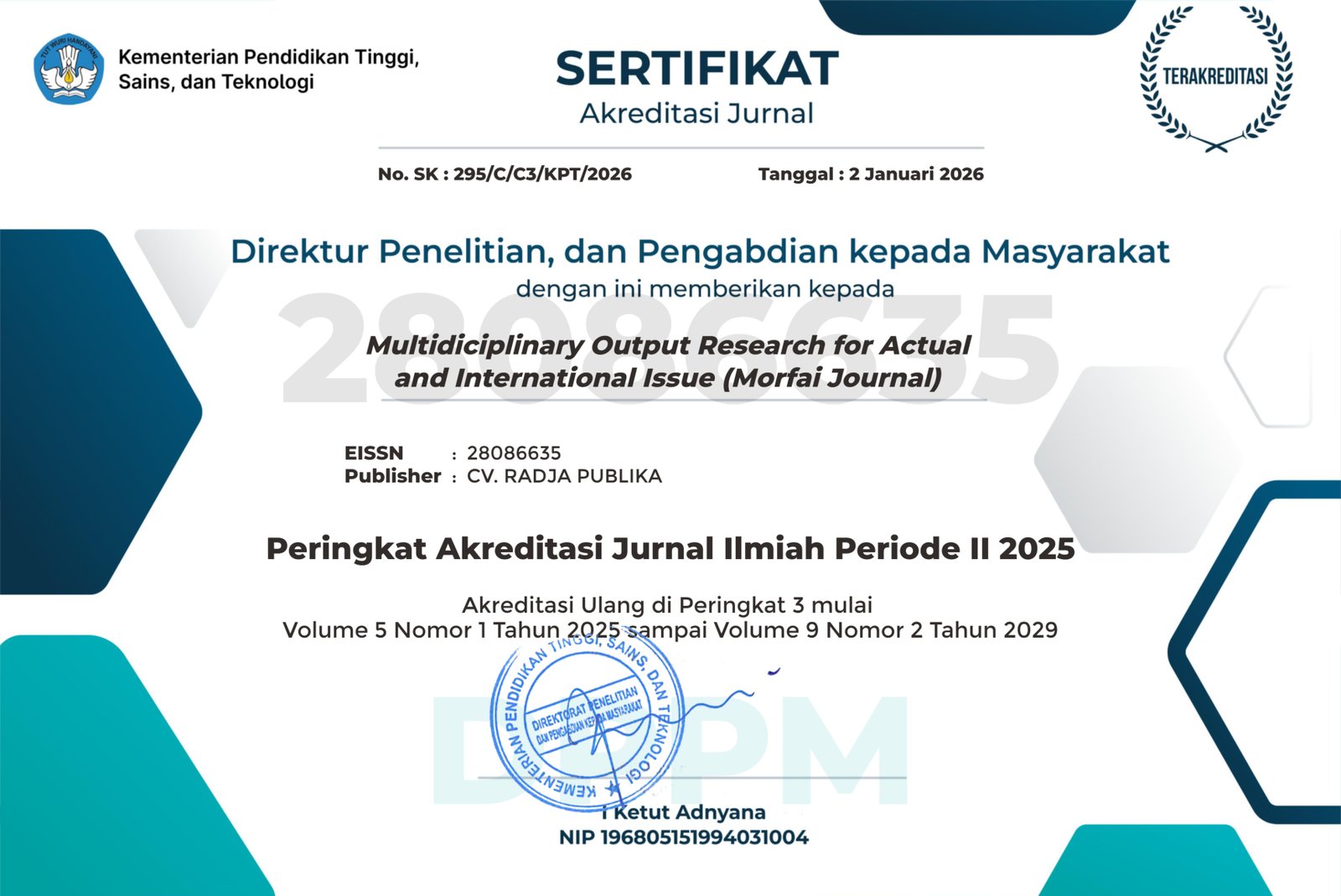
THE IMPACT OF PLAY-BASED LEARNING ON COGNITIVE DEVELOPMENT IN EARLY CHILDHOOD EDUCATION
Published:
2025-05-29Downloads
Abstract
This study aims to analyze impact of play-based learning on cognitive development in early childhood education, synthesizing findings from recent studies to provide a comprehensive understanding of how different types of play contribute to various cognitive skills in young children. This study uses a qualitative research methodology with a literature review approach to examine the impact of play-based learning on early childhood cognitive development. A literature review was selected to synthesize existing research, identify deficiencies, and provide a thorough understanding of the influence of play-based learning on children's cognitive skills. The study's findings indicate that game-based learning significantly enhances cognitive skills, including problem-solving, critical thinking, memory, and language abilities. Various types of play, such as imaginative, constructive, and interactive games, each contribute uniquely to different cognitive areas. Thus, games serve not only as entertainment but also as effective tools for promoting overall cognitive development.
Keywords:
Play-Based Learning Cognitive Development Early Childhood Education Guided Play Executive FunctionReferences
Agostinelli, F., & Wiswall, M. (2016). Estimating the technology of children’s skill formation. National Bureau of Economic Research.
Boell, S. K., & Cecez-Kecmanovic, D. (2015). On being ‘systematic’in literature reviews in IS. Journal of Information Technology, 30(2), 161–173.
Braun, V., & Clarke, V. (2006). Using thematic analysis in psychology. Qualitative Research in Psychology, 3(2), 77–101.
Dewi, S. L. (2022). Pengaruh Pembelajaran Berbasis Permainan pada Pendidikan dan Perkembangan Anak Usia Dini. Aulad: Journal on Early Childhood, 5(2), 313–319.
Fatmawati, F. A. (2020). Pengembangan fisik motorik anak usia dini. Caremedia Communication.
Fauzi, A. R. (2019). Response of Pakcoy (Brassica rapa L.) to the treatment of Liquid Organic Fertilizer of Fisheries Waste. Jurnal Hortikultura Indonesia, 10(2), 94–101. https://doi.org/https://doi.org/10.29244/jhi.10.2.94-101
Fauzia, W. (2023). Perkembangan kognitif anak usia dini. Feniks Muda Sejahtera.
Fisher, K. R., Hirsh‐Pasek, K., Newcombe, N., & Golinkoff, R. M. (2013). Taking shape: Supporting preschoolers’ acquisition of geometric knowledge through guided play. Child Development, 84(6), 1872–1878.
Gemnafle, M., & Batlolona, J. R. (2021). Manajemen pembelajaran. Jurnal Pendidikan Profesi Guru Indonesia (JPPGI), 1(1), 28–42.
Ginsburg, K. R., & Health, C. on P. A. of C. and F. (2007). The importance of play in promoting healthy child development and maintaining strong parent-child bonds. Pediatrics, 119(1), 182–191.
Gray, P. (2011). The decline of play and the rise of psychopathology in children and adolescents. American Journal of Play, 3(4), 443–463.
Harahap, R. A. S. (2022). Mengembangkan kreativitas anak usia dini melalui bermain. Jurnal Pendidikan Dan Konseling (JPDK), 4(5), 625–630.
Hartati, S. (2023). Pembelajaran Partisipatif Dengan Metode Game Pada Rumpun Pendidikan Agama Islam Di Madrasah Aliyah Negeri (Man) 1 Lampung Tengah. At-Tajdid: Jurnal Pendidikan Dan Pemikiran Islam, 7(1), 110–122.
Lillard, A. S., Lerner, M. D., Hopkins, E. J., Dore, R. A., Smith, E. D., & Palmquist, C. M. (2013). The impact of pretend play on children’s development: a review of the evidence. Psychological Bulletin, 139(1), 1.
Meyer, M., Zosh, J. M., McLaren, C., Robb, M., McCaffery, H., Golinkoff, R. M., Hirsh-Pasek, K., & Radesky, J. (2021). How educational are “educational” apps for young children? App store content analysis using the Four Pillars of Learning framework. Journal of Children and Media, 15(4), 526–548.
Mifroh, N. (2020). Teori perkembangan kognitif jean piaget dan implementasinya dalam pembelajaran di SD/MI. JPT: Jurnal Pendidikan Tematik, 1(3), 253–263.
Moyles, J. R. (2010). The Excellence of play . Berkshire. Open University Press/McGraw-Hill.
Mudrikah, S., Ahyar, D. B., Lisdayanti, S., Parera, M. M. A. E., Ndorang, T. A., Wardani, K. D. K. A., Siahaan, M. N., Hanifah, D. P., Amalia, R., & Siagian, R. C. (2022). Inovasi pembelajaran di abad 21. Pradina Pustaka.
Mutiah, D. (2015). Psikologi bermain anak usia dini. Kencana.
Nofianti, R. (2021). Dasar-Dasar Pendidikan Anak Usia Dini. Edu Publisher.
Nowell, L. S., Norris, J. M., White, D. E., & Moules, N. J. (2017). Thematic analysis: Striving to meet the trustworthiness criteria. International Journal of Qualitative Methods, 16(1), 1609406917733847.
Phillips, D. A., & Shonkoff, J. P. (2000). From neurons to neighborhoods: The science of early childhood development. National Academies Press.
Putra, D. W., Nugroho, A. P., & Puspitarini, E. W. (2016). Game Edukasi berbasis android sebagai media pembelajaran untuk anak usia dini. JIMP-Jurnal Informatika Merdeka Pasuruan, 1(1).
Pyle, A., & Danniels, E. (2017). A continuum of play-based learning: The role of the teacher in play-based pedagogy and the fear of hijacking play. Early Education and Development, 28(3), 274–289.
Ruhiyat, S. (2024). Studi Literatur: Problem Solving Pada Perkembangan Kognitif Anak Usia Dini Melalui Bermain. Jurnal Ilmiah Pesona PAUD, 11(1).
Rumiyati, R., & ZulFitria, Z. (2024). Peran Permainan Edukatif Dalam Pengembangan Keterampilan Sosial Dan Kognitif Anak Usia Dini. Cendikia: Jurnal Pendidikan Dan Pengajaran, 2(7), 468–478.
Setyaningrum, S. R., Triyanti, T., & Indrawani, Y. M. (2014). Pembelajaran di Pendidikan Anak Usia Dini dengan perkembangan kognitif pada anak. Kesmas, 8(6), 243–249.
Sholihah, B., & Wathon, A. (2023). Pengaruh Penggunaan Youtube Animasi Nussa Dan Rarra Terhadap Perkembangan Kognitif Anak Usia Dini. Sistim Informasi Manajemen, 6(2), 168–190.
Snyder, H. (2019). Literature review as a research methodology: An overview and guidelines. Journal of Business Research, 104, 333–339.
Sukirman, S. (2017). Peningkatan atmosfer belajar siswa generasi digital native melalui pembelajaran berbasis game.
Suryana, D. (2021). Pendidikan anak usia dini teori dan praktik pembelajaran. Prenada Media.
Tatminingsih, S. (2019). Alternatif stimulasi kemampuan kognitif melalui penerapan model pembelajaran berbasis permainan komprehensif. Jurnal Obsesi: Jurnal Pendidikan Anak Usia Dini, 3(1), 183–190.
Tranfield, D., Denyer, D., & Smart, P. (2003). Towards a methodology for developing evidence‐informed management knowledge by means of systematic review. British Journal of Management, 14(3), 207–222.
Uce, L. (2017). The golden age: Masa efektif merancang kualitas anak. Bunayya: Jurnal Pendidikan Anak, 1(2), 77–92.
Vygotsky, L. (1934). Thought and Language. In Language and Thinking. Harmondsworth: Penguin Education.
Weisberg, D. S., Hirsh-Pasek, K., Golinkoff, R. M., Kittredge, A. K., & Klahr, D. (2016). Guided play: Principles and practices. Current Directions in Psychological Science, 25(3), 177–182.
Weisberg, D. S., Hirsh‐Pasek, K., & Golinkoff, R. M. (2013). Guided play: Where curricular goals meet a playful pedagogy. Mind, Brain, and Education, 7(2), 104–112.
Whitebread, D., Basilio, M., Kuvalja, M., & Verma, M. (2012). The importance of play. Brussels: Toy Industries of Europe.
Wulandari, H., & Lestari, L. (2023). Pentingnya Pemahaman Guru Paud Terhadap Perkembangan Motorik AUD. Ceria: Jurnal Program Studi Pendidikan Anak Usia Dini, 12(1), 13–29.
Yin, R. K. (2018). Case study research and applications. Sage Thousand Oaks, CA.
Zigler, E. F., & Bishop-Josef, S. J. (2004). Play under siege: A historical overview. ZERO TO THREE/National Center for Infants, Toddlers and Families.
License
Copyright (c) 2025 Yuni Misrahayu

This work is licensed under a Creative Commons Attribution 4.0 International License.
Downloads
How to Cite